Monthly Archives: August 2016

Permaculture and the Psyche Part 3: Least Effort for Greatest Effect

IMG_7749Bertolt Brecht said “Grub before ethics.”  Maslow said there is a hierarchy of needs: one must first have food, shelter, fire, and water before she can focus on self-development or creativity.

If certain needs are not met, we stop developing.

This is as true of gardens as it is of people. If the soil on your land is depleted, no amount of backbreaking tilling, planting, or weeding is going to ensure a good harvest. But a tiny investment in building the soil will yield spectacular results.

If you are deeply exhausted, investments in education, nutrition, and exercise are not going to pay off. But if you give yourself a bit more sleep— everything transforms.

The principle of least effort for greatest effect has a beautiful assumption at its center: you are already moving toward self-realization. Everything is. You do not have to work and work and work to achieve perfection. Your only job is to discern what obstacles are hindering your natural perfection, and remove them.

By perfection, I do not mean the kind of perfect that is the enemy of the good. I mean a living, breathing balance, such as we see in a climax forest or a well-nourished, well-loved child. In natural perfection there is always room for growth, but there is nothing actively hindering that growth.
2013-12-23 11.59.32

Sometimes the obstacles are blindingly obvious: racism and poverty and other inequalities jump immediately to mind. Other times they are more insidious; we think we need to work harder when really we need to relax and be more receptive. We think we need to explain when really we need to listen. We think we need a brownie when really we need a hug. We think we need a hug when really we need a brownie.

If we can somehow open ourselves to the idea that we are intrinsically fine just as we are, the obstacles start to reveal themselves. What, then, is hindering us? Do we need shelter? Water? Fire? Food?

Do we need someone to listen to us? Do we need an hour more sleep per night? Do we need a room we can be alone in? Do we need a schedule that allows us to sleep late, or rise early?

Do we need to be working in a field that utilizes our natural gifts rather than deadens them?

IMG_2365

Do we just need a freaking cape? 

Five minutes spent removing an obstacle to your natural progress is worth a year’s hard labor fighting your own natural tendencies. That’s an actual statistic I made up.

So: how do we learn what our natural plan is, and what our obstacles are?

On Wednesday night we used two of my favorite tools, the Ikigai Venn diagram and the Merlin Process.

ikigai.jpg (825×820)

To find your Ikigai, you look at the areas of overlap between your talents, your training, your passions, and the needs of the world. You find the sweet spot that encompasses all four, and THAT is where you put any extra energy, time, or money.

Tiny efforts in the area of your Ikigai yield exponential effects, because your passion and education and talent line up to push your ideas into the world.

(And if you need a refresher on how Venn diagrams work…

IMG_7966

…that should do it. )

Merlin Process is a joyful, heady way to trick your brain out of the insecurities that thwart you from achieving your Ikigai. Here’s how it works: Merlin is said to have lived backwards through time. Legend tells of his birth as an old man and his death as baby. The glory of this backward trajectory was that Merlin never had to worry about his future; it had already happened! We can play with this magic ourselves, by pretending our future is already in our past.

It works like this.  Take a little time and work out your Ikigai by making lists of the things you love, the things you are good at, the things you can get paid for, the things the world needs. Notice the areas of overlap. Work your Ikigai until you have it down as a sweet, solid sentence.

Now find an open-hearted friend and talk for five minutes IN THE PRESENT TENSE about how your Ikigai is the center of your life now. For example, if my Ikigai is to write and work with women on the overlap between ecology and psychology to solve personal and global injustices (which, by golly, it is!) then my Merlin Process conversation might go a bit like this:

Me: Wow, so, five years ago I remember sending my first book about permaculture and psychology off to the publisher….so much changed after that! I remember how I started traveling to talk about the book, and set up so many workshops and retreats for women who were suffering, and how the proceeds from book sales and the nonprofit I set up funded so many trainings for women all over the world. It feels so good that my job is to have my hands in the earth and to laugh with women, and I never have to get up before 8 am. I love how my needs for sunlight and laughter and connection and the outdoors are all fulfilled by my work, and it is so amazing to me that I can offer counseling and retreats to the women who most need it, women who would never be able to pay for these services if it weren’t for the incredible donors to my nonprofit and the proceeds from my books and gardens. It astounds me to have a life that leaves so much room for free days with my children, and travels with my beloved; I feel so at service and yet life is not drudgery. It means the world to me that I can respect my natural rhythms and take time for rest during my moon cycle. I love that the work I do leaves no footprint on the earth except for lands that are more deeply loved, lives that are more carefully tended.

Friend: Wow Lissa, tell me more about what your life feels like now! How on earth did you do that?

_________________________________________________


Continue this conversation for as long as you want—you may surprise yourself with what you already know about how you got where you want to go! (And switch off with your friend so that everybody gets a turn being Merlin!)

Here’s another amazing story of least effort for greatest effect: Trees for Life and the instant forest . It also serves as a segue into next week’s workshop, our final exploration: the problem is the solution.  (my favorite!)


If you want to attend the permaculture and the psyche workshop on Wednesday, email maevehendrix@gmail.com to reserve a spot.

And if you do engage in the Ikigai/Merlin process above, I would LOVE to hear from you in a comment what you discovered about your purpose!

1 Comment

August 28, 2016 · 9:31 pm

Permaculture and the Psyche Part 2: Stacking Functions

IMG_8026I have been wearing this bracelet since Wednesday evening. It is very simple; one bead of Czech glass, one of jasper, and one of turquoise. As I type or write or lift a cup of tea to my lips, I let my eyes rest on these simple beads and a sense of purpose fills my heart.

On Wednesday, we met for our second week of Permaculture and the Psyche workshops. This week we discussed the practice of stacking functions: the ecological imperative of multifunctionality. The bracelet I now wear was the result of the lengthy artistic process: first we discerned our needs through writing, yoga, and co-counseling; then refined them through guided meditation; finally we made them tangible through the selection of beads to represent each core need. Now, every time I gaze at my wrist, I am reminded of who I want to be, what I want to be doing, and how I want to experience my life.

IMG_7975

Stacking functions, in permaculture design, is about getting multiple needs met with a single element. You may be familiar with the Three Sisters garden in which corn, beans, and squash are grown together. This garden stacks functions beautifully: the corn serves the function of both food and a pole for the beans to climb on. The beans serve the function of fixing nitrogen to replenish the nutrients that corn, a notorious heavy feeder, draws from the soil. Squash spreads between them, serving the function of shading the soil to minimize water loss through evaporation and also shading out any weeds that might compete with the corn and beans. By stacking these functions with clever interplanting, the three sisters garden does away with the need for poles, fertilizer, mulch, water, and the labor of weeding!

three-sisters-f

We can “stack functions” in our own lives by meeting several core needs with a single action. I gave this example on Wednesday:

after work each day, I have an hour or so to transition from the work environment to my home. I spend my days in a small office, away from the sun and light of the outdoors. I want to get outside and see my friends. I want to move my body and renew myself from any difficult encounters. But with all of these needs to meet, and only an hour in which to meet them, it behooves me to stack functions! I could go for a run and meet my need for sun and exercise. I could take a friend for a drink and fulfil my social need for friendship. Or, I could walk to the yoga center and ask a friend to join me in a yoga class, thus meeting my needs for motion, friendship, renewal, and sunlight in one fell swoop!

Of course, our needs change every day. It is important to remember to cultivate that internal witness (last week, we processed the permaculture principle everything gardens, using yoga, meditation, and artmaking to cultivate the inner witness. We learned how to observe the forces gardening and shaping us just as a permaculture designer observes the light, wind, and water that moves across a landscape. Read this post for more) so that we stay flexible in our responses. Some days I don’t want to be social and active at all; my body tells me to go home and sleep! But maybe I can walk home, and change my route to include the grocery store, so that I stack the functions of preparing for dinner and getting some sunlight and exercise into my journey.

Discerning the core needs of a system is the first step in any good design. We do this through observation and the careful collection of data. Every piece of land is yearning toward something; left alone; it will go through a process of natural succession and arrive at a humming homeostasis, whatever the climax community is for that particular piece of land.

There is a phenomenal amount of potential energy in that groundswell. When we fight that energy, say by plowing a piece of land and inserting rows of tomato plants, we set ourselves up to battle weeds, insects, erosion, and disease.

Picture

But if we observe, and discern what the land wants to be, we can use design as a bridge to meet all the needs of the system with plants that are useful to us. Then, that groundswell of energy will surge forward through the design instead of against it. In temperate forest like we have here in Asheville, we might plant a forest of fruit and nut trees, edible and medicinal shrubs, and edible-tuber, edible-green, or insectary ground layers wound through with wild grape to mimic the composition of the forest this land wants to be. Such a design, if well-implemented, will fare far better than the rows of tomatoes.

The difference between a tomato garden and a food forest is one of complexity and relationship. The way we design relationship and complexity into our gardens (or our psyches!) is by stacking functions: placing each element of our system into elegant relationship with other elements in order to meet our needs as efficiently as possible.

IMG_7836It is important to note that stacking functions is just one part of the equation. There is another permaculture principle that reminds us to design in multiple elements for each function: the reverse of stacking functions. Imagine, in the three sisters garden, if there were to be a terrible drought. Yes, the large squash leaves shade the ground, helping to conserve water in the soil, but if there is no water there to conserve, all three plants will die. We need to have a back up system, perhaps a well-placed rain barrel  to collect roofwater from the garden shed, to meet the function of watering in case our first element fails.
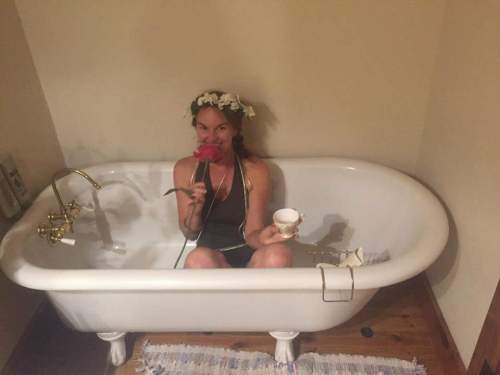
Last year, my stomach muscles split open in a severe case of diastasis rectii and major surgery was required to repair the damage. I discovered very quickly that I had become reliant on physical exercise as my only stress-management tool. Lying flat on my back for the months of surgery recovery, I had to quickly re-learn the importance of designing in multiple elements to meet core needs! Now, I have learned to process stress by meditating, talking with friends over tea, and writing (although exercise is still my go-to!) This way, my entire stress-management system won’t crash the next time I experience injury.

IMG_7964

me, managing stress


This process of observing life, discerning core needs, and designing strategies to meet them efficiently (with back ups!) can sound a bit exhausting.  Applying our intelligence—even our awareness!—consciously to our lives is not something that most of us are taught. But I have found that when I take the time to observe myself and my true needs, I can design a life that works with my natural tendencies rather than fighting them. In the long run, this saves immense amounts of mental, physical, and emotional energy and pain.

If you want to play with this process in your life and make your own stacking-functions bracelet, read on!

Below, I’ve included a script for three guided meditations we worked with on Wednesday. Get a pen and paper, a handful of beads, and something to string them on. Find a quiet place, light a candle and some palo santo or sweetgrass, and read these meditations to yourself or have a friend read them to you.

1. Close your eyes and bring your awareness down into the very center of your self, breathing deeply and low in the belly. Find the beat of your heart and smile at the heart, notice if the heart smiles back. Breathing deeply, imagine the face of a person that you admire or even envy, a person whose way of being in the world fills you with a longing, an edge of wanting to become MORE…. Perhaps you’ve never met this person, only read of their physical or mental or spiritual accomplishments. Or maybe this is a friend whose way of being in the world inspires you…. Imagine the face of this person, their eyes, their posture as they carry themselves through the world…. Notice the effect they have on the world around them, what they are doing, the expression on their face…  What is the essence of this person you so admire?…    Really looking at this person, what is the word that describes their way of being in the world?… If you had to condense what it is that you so admire about them into one concept, what would it be? …

Breathing low in the belly, allowing this image of the person you admire to dissipate, keeping the word. Smiling at your heart, noticing if your heart smiles back. Coming back to the room, quietly write your word down and then close your eyes once again.

2. Now, eyes closed, breathing deeply, come back to that place in the center of yourself, finding the breath low in your belly, finding your stomach and smiling at it. Notice if it smiles back.  Breathing into this smile, settling deep into your belly, picture the last time you read about something in the world that made you tear up. What do you see, or read, or hear about that fills you with a burning rage, or overwhelming joy, or a deep sorrow? What is it in the world that deeply moves you or what is it that you cannot stomach? Picture the last time you were talking so passionately about something that your heart was pounding and you couldn’t keep up with your own words. What were you talking about? …Let these memories surface, watch them, and find what is at the heart of them. What is the issue that burns brightest in your heart? What calls to you most strongly in the world? Find its essence in a single word.

Breathing deep into the stomach, letting these memories and images go, keeping the word. Smiling at your stomach and noticing if it smiles back. Bringing your attention briefly back to the room, quietly write this word down and then close your eyes once again.

3. Now, eyes closed, come back to that place in the center of yourself, finding the breath deep and full. Bring your attention into the silver lobes of your lungs. Smile at these temples that connect you through breath with the rest of life. Smile at them, and notice if they smile back.  Breathing into this smile, settling deep into the fullness of the lungs, picture yourself in the place you feel most radiantly comfortable, alive, and happy. What is the place most sacred to you? Is this place outside, inside? What does it smell like? Is it bright or dark, cool or warm? What are the colors of this place, what do the textures feel like against your skin? What is it about this place that feeds you? What makes it sacred, what sets it apart from other places? How do you feel when you enter it? If there were a single word that could contain the feeling of this place, what would it be? Find the essence of this sacred place in a single word.

Breathing deep into your lungs, letting these images go, keeping the word you’ve found. Smiling at your lungs and noticing if they smile back. Slowly bringing your attention back to the room, quietly write this word down and, when you are ready, look up.

The meditations will leave you with a list of three words. Take your three words and really look at them. These three words make up the core of what is most important for you to be, do, and experience. These are the elements you want to stack in to your life design.

What currently meets these needs for you? Where in your life do you get to be the quality of the first word? Where in your life to you get to do work that addresses the second word? Where in your life do you experience the feeling evoked by the third word?

Select three beads whose color, shape, or symbol invokes each of your three words. These three beads will be the centerpiece of your talisman, reminding you always of the core of who you want to be, what you want to do, and how you want to experience life.

Tie them onto a string and wear them around your wrist.

As you make decisions throughout your day, look at these beads and quietly repeat the words to yourself. As you choose how to spend your time, ensure that these three vital needs are met in as many ways as possible. Pay particular attention to people, activities, and places that meet all three.  As you go through the day, notice ways you can build in back-ups for these needs. With every decision you make, give first consideration to meeting these needs.

 IMG_7838

Next Wednesday, we are meeting at The Enneagram Center in Asheville to explore the permaculture principle of least effort for greatest effect through yoga and the expressive arts.  If you’re in the area, join us by emailing Maeve Hendrix(maevehendrix@gmail.com); if not, stay tuned and I will write about the experience next week!

Leave a comment

August 20, 2016 · 1:16 pm