Women’s Joy Circle: Do Not Disturb

Barbed wire (rusting after years of hard work)...

For my half-birthday this year I sent out a letter to people I greatly respected, people who have known me through very diverse stages of my life, some dear old friends and some passing acquaintances.  I asked them to bravely, honestly, share with me what they saw as my challenges.  And I asked them to answer this question:  if you could wave a wand and ‘fix’ me without ever having to worry about my knowing or being offended, what would you change?

I did this because I was in one of those troughs of experience in which I had finished up one phase and not yet discerned what was next, and I wanted to choose wisely.  I wanted to step bravely into my strengths and shine a light on some of my weaknesses, to carve out new ways rather than following old comfortable paths.

Receiving the answers was terribly scary and difficult.  Part of me desperately hoped for responses of “I wouldn’t fix a thing!  Nope, you’re absolutely perfect as you are!” (even though I’d expressly forbidden anyone to answer that way.) But the curious, contemplative side of me wanted to know.  It wanted those shadows aired.  And I am so glad that my brave, wonderful friends responded to that side of me.  Their bravery started this blog, because one response I heard over and over again was that I needed to share my writing. Continue reading

4 Comments

June 11, 2013 · 3:42 am

Women’s Joy Circle: Internal/External ways of knowing

Giuseppe Arcimboldo - Farm Woman Going to Mark...

Giuseppe Arcimboldo – Farm Woman Going to Market

In the normal course of things, writing comes to me like breathing.  I do it without thinking.  When I sit down to write an article or a post or a letter, I am more mindful of writing, just as I am more mindful of my breath during a yoga class or meditation.  But it is still an involuntary process, flowing through me, requiring little of me.

Lately this has not been so.  It’s been a tumultuous few weeks: last week I traveled to Indiana with my parents and children to visit our family matriarch, a powerful woman of 95 years who ran a dairy farm alone after her husband dropped dead, leaving her with three small boys and pregnant with a fourth.  From all accounts, Grandma’s  early life was pretty joyless: an unhappy marriage followed by an even unhappier widowhood, constant struggle with poverty and endless hard work, a tornado that destroyed her entire town, hopes for a second marriage that were cruelly dashed, an unsupportive and judgmental extended family and church community.

As an adult, I can see all of this.  Yet as a child, my experience of Grandma was her ever-present gravelly chuckle, her bustling busy-ness as she baked and crocheted and painted, utter delight in her work as a hairdresser and in her family.  Grandma always sent buckets of presents for Christmas, and her house was full of art and candy.  Her hair was always perfectly curled and colored, her eyes were always sparkling.  She gave me my first “permanent” when I was 12 years old, treating me as a co-conspirator in my endeavor to be beautiful despite the disapproval of my staunchly anti-chemical-hair-enhancement parents (the heathens!) Continue reading

4 Comments

June 4, 2013 · 7:38 pm

rose hip soda

English: Some rose hips in close-up

In college, I built myself a thatch hut and lived in the woods on a bed of leaves and cattail down.  I foraged for food in baskets I wove of kudzu and honeysuckle vines.  And under that bed of leaves, right on top of the hand-hooked rag rug made of my old t-shirts, was my secret stash of Diet Coke.

I have finally, many years later, completely weaned myself off of corn-syrup or chemical-cocktail sweetened sodas.  But I am still a sucker for a fancy fizzy drink!  There is something that sings to me about a sun-drenched porch on a sweltering day, listening to the soft fizz and clank of ice cubes in a cold glass.

So I have learned to make my own sodas.

Here is my current favorite recipe:

Rose Hip Soda

2 tbsp. dried rose hips or 1/2 cup fresh

1/2 cup agave nectar or honey

1/2 cup kefir grains or 1 cup kefir whey or yogurt whey

1/2 organic lime

filtered water

~Place the rose hips, sweetener, and kefir grains or whey into a two-quart jar. Squeeze the lime juice in, then cut up the peel and throw it in too.  Add enough filtered water to fill the jar.

~Screw the lid onto the jar and leave it in a warm place for 2 days.

~Strain the soda into two glass bottles (empty mineral-water bottles or swing-top bottles are great).  Add enough water to fill to the very top. Screw the lids on tightly, label, and return to a warm place for another 2-3 days. Transfer to the fridge.

~Open them carefully and over a sink—they get REALLY fizzy.

~Pour over ice, add a slice of lemon, and sit on your sun-drenched porch!

I make this recipe with lavender too, which is DELICIOUS, substituting dried lavender flowers for the rose hips and lavender-infused raw sugar for the honey.

20130515_154019

If you are unfamiliar with kefir grains, they are a lovely little squishy organism that you use to make your own kefir (or, as it happens, soda.)  If you do not have kefir grains, check to see if there is a chapter of the Weston A. Price foundation near you; often these gatherings are replete with kefir and kombucha and other fun k-things.  Or you can use whey from homemade yogurt (or store-bought if it has live cultures and isn’t sweetened).  The whey is simply the watery part.  To obtain kefir whey, let your kefir sit out a day longer than you would normally to make it, and it will separate into curds and whey.  Strain out the grains, pour off the whey, and use the curds to make kefir cheese!

This recipe is adapted from Full Moon Feast by Jessica Prentice, which is highly recommended for anyone who likes a little bit of storytelling and cultural history with their recipes.

1 Comment

May 23, 2013 · 4:15 pm

Women’s Joy Circle: First Response

English: Strawberry flowers. Français : Fleurs...

Last week my children decided to stay in Meeting with me.  (Meeting is the Quaker form of worship, and it consists of an hour or so of silence.  There is no planned music or ministry, though anyone who feels led to speak may do so.)  Normally, my children sit with me for ten minutes or so, then leave with the other children for their own program.  On this day, who knows why, they wanted to stay.

There followed the most interesting 40 minutes of mental acrobatics in my life.

My goal was to maintain the settled silence.  I therefore could not use any of my normal methods of guiding my children—talking, explaining, separating, demonstrating, disciplining.  They, as 8 and 4 year olds, were wriggly and interested and had things to say and places to go. At one point my 8 year old reached up around my neck and removed my necklace, uttering in a harsh whisper “this is MINE.”  He then proceeded to put it around his own neck.

I had a very strong immediate reaction of anger.  The first response that went through my head was to take the necklace away and talk to him about the rudeness of his action.  But it was Meeting for Worship.  I knew that to do so would set off an emotional (read: LOUD) reaction from him, and we would seriously disturb everyone else.  So I sat there and simmered.  The second response that occurred to me was to walk him out of the Meeting room and talk with him about proper etiquette in Meeting.  But again, our leaving would cause a disturbance as well as a probable upset for my 4-year old, and it would sort of defeat the purpose of explaining Meeting etiquette if, to do so, I had to violate it.

We sat there, and third and fourth and fifth responses ran through my mind, none of which I could act upon.  And then, as the silence gathered, between adjustments to small wandering feet and hands that kept making their ways onto various parts of my body, the responses deepened.  Now, rather than being knee-jerk emotional reactions to the stimulus, they were considered and heartfelt responses.  I thought about the ways in which my son’s belief in his ownership of the necklace was justified.  I thought about the deep roots of my angry response, why it was that I felt so violated.  I thought about how my daily interactions with my son can so often devolve into stimulus/response, almost scripted interchanges.

By the end of Meeting I had decided to act upon my 347th response, which was to have a long talk with my son about the kind of human being I hoped he would grow up to be.  And that’s what I did.  All the way home, walking and gathering flowers, we talked about what a good man is, both in his view and mine.  I really listened to him.  He really listened to me.  I told him that reaching into a woman’s space like that and taking what he wanted really disturbed me, and I told him why. It was an amazing conversation.  It could never have happened had I followed my first response.

First responders are emergency workers.  They are trained to act swiftly and decisively in emergency situations.  In these circumstances, going with the first response is highly recommended.  But how often are we in emergency, life-or-death situations?  I know that for many of us, the stress of daily life triggers fight-or-flight responses from our nervous system far more often than is necessary, with terrible consequences to our health.  Might this be true for our mental experience as well?  Might it be true that going with our reflexive, knee-jerk first response in nearly every situation is harmful to our mental and emotional health?

At women’s joy circle on Monday, we explored this idea.  We spent a lot of time in yoga, warming and opening our bodies with deep, conscious breathing. Then we gathered in a circle and talked about first responses.  We talked about how many of our interchanges are scripted:  “Good morning!”  “Good morning.”  “How did you sleep?” “Fine.”  “How was your day?” “Great.”  “Have a good one!” “You too.”  We talked about how easy it is to fall into these patterns of exchange and never really communicate at all.  And then we did this exercise:

Number a sheet of paper from 1 to 15.  Your partner asks “How are you today?”  Write down your first response.  Again, your partner asks “How are you today?” Write down your second response.  Continue until all fifteen spaces are filled.  

This gets reaaaaally interesting right around response #8.  Authentic communication starts to break through.  In the circle, we shared some of our favorite responses and got everything from “filled with light and love!” to “incredibly sad” to “did you have a favorite umbrella as a child?”

Pairing off, we practiced communication beyond first response.  Each partner responded to the questions and comments of their counterpart in a normal dialogue, with the caveat that no first responses could be used.  No one spoke until the third or fourth response had presented itself.

We had an odd number of women, so I sat out and listened.  What fascinated me most was how incredibly interesting the conversations became, within the space of just a few minutes.  There was a lot more silence than occurs in a normal conversation too, as people considered their responses.

We closed with rose petal tea and cookies and brags and dancing.  Everyone had a difficult time leaving.  True communication does that to people!  Many of us decided to practice using third, fourth, fifth responses in the kind of pat conversations that occur with cashiers or bus drivers or other parents at school, and to see what happens.  Here’s mine from yesterday morning:

Parent of child in my child’s class: Good morning!

Me: I know that it could be, but I’m feeling off today.

Parent: What happened?

Me: I don’t think anything happened.  I think I’m frustrated with myself for not following through with promises I’ve made.

Parent: what sort of promises?

Me: Promises to myself, mostly, about how I want to spend my time.

Parent: You know, I do that too.  I’ve been wanting to go berry picking for several days now, and I keep getting caught in other stuff, and I’m going to miss the window of opportunity.

Me: want to go berry picking today?

Parent: great idea!  let’s bring the kids and do it this afternoon!

Berry Picking Children a Summer Day

it didn’t look like this, though.

We had an incredible time.  It was so much better than “good morning/good morning/see you later/goodbye.”

5 Comments

May 22, 2013 · 5:16 pm

Women’s Joy Circle: Healing

English: Molcajete y tejolote, (mortar and pes...

I’ve been thinking a lot about healing lately.  I am taking 7Song’s Herbal First Aid class remotely, and dawnings of understanding about the body’s capacity to heal are beginning to break through.  To heal the body, I’ve learned, you clear away anything that might be interfering with the body, and then allow it to heal itself.  The antimicrobial and sedative and carminative herbs we prescribe do not, per se, heal the body.  They relieve symptoms, help deal with invaders and optimize healing conditions, yes–but it is the body that heals.

And since we are beings of mind/body/spirit…not just one or the other, but all, always…it is also so with healing the spirit.  Heartbreak and grief and emotional exhaustion can’t be “fixed”.  Healing is not something you add to your routine like a bandaid.  Healing, for the heart, is just as it is for the body.  You remove everything that is impeding it.  It is already there.

I think about this in terms of my young motherhood.  There was little sleep, there was screaming and crying and utter exhaustion, there were ceaseless cycles of not-having-enough-hands, there were impossible gordian knots of chaos that seemed interminable.  And then, suddenly, about a year ago, I realized that this part was over.  I’m still not sure when it happened, but somehow, at some point, my children learned to bathe and feed and dress themselves, and to walk around without impaling themselves on butterknives or hurling themselves over cliffs, and there were, all at once,  moments of serenity between the gordian knots of chaos. I did not have to learn that serenity.  It was always there, simply waiting for its chance to emerge.

IMG_2365

And I believe this is the human condition.  It is interesting to think of God/Goddess/Spirit/Tao/Universal Intelligence as a young mother, marshaling the growth of this immature, spirited baby species, utterly exhausted by us.  It pleases me to think of it this way because then I can believe that our evolution is not meant to be a slow, steady progression toward “good” and “right” and “balance”—because, if it were, there is no evidence that we are progressing at all!  Perhaps it is instead this chaos of fits and starts—exhaustion and misery and impossible complication—and then, suddenly, moments of clarity and peace, of deep understanding and beauty.  And then the swan dive back into the chaos.  (Because I don’t for a moment imagine I’m out of the woods.  Teenage years start in T minus 5 x 365 x 24 hours).  If this is so, then there is hope for us.  There have been these moments of deep beauty and understanding and there will be again, the chaos of war and genocide and genetic engineering and sex trafficking notwithstanding.  We don’t inch toward perfection.  Perfection is already there, and from time to time we manage to peel away the outer circumstances concealing it.

We circled up on Monday and shared, as usual, first our names and then one word to describe ourselves at this moment.  I am always amazed by the articulations:  overjoyed.  frazzled.  overcome. happy. grieving. in my center. nervous. giving it a shot. healing. frantic. healing.

Using the word “healing” as a focal point, we settled in for a long, slow yoga practice.  We noticed what parts of our bodies responded to the word “healing” and what emotions it elicited.  We did a lot of cyclical movement, hip circles and knee circles and shoulder circles and circles of the head and ribs.  We checked in with our center by doing cat/cows in forearm plank position.  We spent long moments in child’s pose, compressing the third eye, scanning the body for areas of tightness and coldness and pain, using the breath to melt them down and open.  Yoga is wonderful for asking the questions of the body that a good herbalist would ask of the patient.  What is going on in the body?  Does this hurt? Do you feel cold or warm?  What moves easily?  What feels stuck?  I love my yoga practice for reliably peeling away one of the layers between me and healing, that layer of disconnection with my body.

English: Udara Shavásana Português: Udara Shav...

ahhhh.

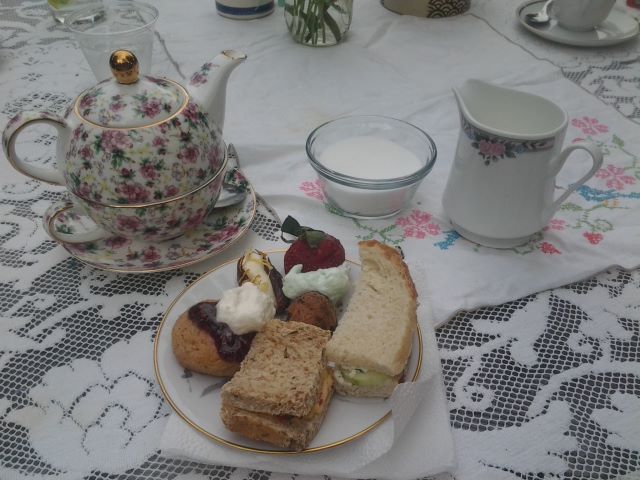
Then we ate some of the 756 leftover scones from the herbal high tea (slight miscalculation.  Sorry Molly) and sipped tea while I discussed the next exercise.  I like to call it “The Two-Year-Old.”  You sit facing your partner and ask them “What hurts?” and they answer. When their words slow or stop, you ask “Why?” They answer again, and you continue to ask “Why?” for five minutes.  Have a pillow ready so that if they try to punch you in the face you can protect yourself.  I’m kind of kidding, a little.  But kind of not.

Then you ask your partner: “What do you want?” and allow them to answer.  When their words slow or stop, ask “Why?”  and continue as before.  Go for five minutes.  Then switch and have your partner ask you both questions.

Getting to “Why” is fascinating for so many reasons.  For one thing, you get to discover what makes you angry—usually just past that point of anger and annoyance is a very interesting insight.  For another, you get to discover the similarities between what you most want in this world and what has most hurt you.  You get to see that what you really want is inextricably tied in with what needs healing in you, because what hurts us in the world, what feels painful or isolating or deeply wrong, is what we are strongly called to fix or make right.  I have found that my deepest pleasures in life have been the moments when I can prevent someone from being wounded in the ways I was wounded, or create circumstances that bring joy and connection where I once felt alone or isolated.  I know that this is my work, and my healing process.  As I peel away the layers of misunderstanding and pain and rote behavior that keep me hurting, I heal both myself and my world.  Not by “fixing” anything.  Just by revealing the beauty that was already there.

I feel another “Permaculture and Parenting” article coming on, about removing limiting factors.  I so love this principle, that the perfect ecosystem is already there if you just set it up, get out of the way, and let it thrive.  That miracles happen in Zone Zero and Zone Five.  That you always leave a little wilderness as example and seedbank.  That the chaos is part of it all.

moments of serenity: our lovely Herbal High Tea

moments of serenity: our lovely Herbal High Tea

3 Comments

May 15, 2013 · 4:05 pm

Women’s Joy Circle: relationship

English: Flow of Merced River after Autumn's r...

Here in North Carolina it has been raining nonstop for close to two weeks.  Long walks of exploration through newly roaring creekbeds and exciting leaf-boat journeys down gutters aside, it gets depressing.  When we assembled last night for joy circle, I could feel it in the room.  We were all out-of-sorts.

I have learned through hard experience that when I am facing turbulent or charged or discombobulated energy, the only way out is through.  I can’t pretend it’s not there or fake it until I make it or put on a glossy mask and act as though I’m utterly self-possessed.  I have to jump into the messy emotions and the fear and the not-knowing until things change.

So I threw what I had planned out the window.  Next week is our herbal high tea, and there was loads of planning to be done, but none of us were in a “planning” kind of space.  I took some deep breaths and did a quick internal scan of what had been coming up again and again this week.  And what emerged was relationship.  Disintegrating relationships, or painful confrontations, or loneliness, or longing, or miscommunication.  So many friends had been calling to talk about this, so many articles and conversations and books had turned up to shed light on it.  We would explore relationship tonight.

Supine Pigeon

pigeon pose…compressing the third eye is wonderful for the nervous system

We started with some very slow, deep hip openers.  All of us store emotional tension in our hips, but for women especially the practice of hip-opening stretches like thread-the-needle or pigeon can be very intense and cathartic.  We warmed up with cat-and-cow and slow vinyasa, then took our time in pigeon, using the breath to expand on the inhale and fall down on the exhale, compressing the third eye on our doubled fists or the floor.  From this place of release we slowly resumed a seated position and went through a guided meditation.

In the meditation I asked everyone to identify a pattern in their relationships that has caused pain.  It could be a pattern of abandonment, or betrayal, or loneliness, or a sense of unworthiness…any painful experience that seems to repeat from lover to lover or friend to friend.

When we think of these patterns it hurts.  We followed the pain within, to the place in the body it seemed to originate.  There, in the body, we stayed, feeling the pain, noticing the sensation it caused.  I asked:  if this feeling had a voice, what would it be saying to you?  What is its message?

I could see the messages on faces lit by flickering candlelight:  you’re impossible to love.  you’re not good enough.  you try too hard.  you don’t try enough. 

I asked everyone to identify the age of this voice.  Was it a little girl speaking?  A teenager? A grown woman?  And  I asked each woman to return for a moment to her breath, to her own power and centeredness.  From this place of adult self-assurance, I asked each woman to extend her love and power to that voice, to contradict the message that caused such pain, to envelop it in love and warmth and safety.

And then I asked for each woman to conjure up within her body the feeling of being loved.  The feeling of being adored, cherished, cared for.  I asked for each woman to draw this feeling through her body with the breath, filling each cell with that sensation of warmth and bliss.  I asked each woman to imagine her ideal mate sitting before her, regarding her with complete love and acceptance, and to notice how that felt.

I put a paper and pen in front of each woman and, still in a space of candlelit silence, asked that they write down how it felt to be loved this way, what thoughts and resistances emerged from this feeling.  I asked them to write who they were within this relationship of love, how they walked when they were loved this way, how they spoke, what changed in their lives, what they let go of, what they learned.

Some women had to leave the room, overcome by trying to imagine a love like this. We are a circle of strong, self-assured women who juggle very meaningful work, studies, care of others, and personal evolution, and yet through each of us runs this fault line of self-acceptance.  We have difficulty creating for ourselves what we effortlessly give to others each and every day.  I never fail to be blindsided by this paradox.

When we gathered again over tea and lavender scones, the energy was subdued.  We had touched on something deep and vulnerable.  I talked a little about vulnerability, how it is the only way into communication, how the high gloss of self-sufficiency repels every attempt at connection.  I know a lot about this.  That doesn’t make it any easier.  I spoke about ways to use what we had learned: taking what we’ve written and using it to create a sense of expansiveness and love in our own lives, now, making the changes for ourselves that we sensed would happen only when we were loved.

Finally, I gave in to the quiet and turned on the music.  We danced, and outside the rain poured down and lightning flashed in quick illumination of our bodies letting this out, this unutterable paradox of strength and vulnerability, self-assurance and self-doubt.  This feels very important to me.  I think that the unraveling of this question will have a bearing on questions of environmental damage and social injustice and right living and mental health.  I know that our self-relationship has a bearing on our relationship with everything and everyone. I don’t know how yet.  But I am beginning to be clear on the question.

Lightning 2

2 Comments

May 7, 2013 · 9:19 pm

on providence

English: , seen from Howard's Knob.

boone

I spent Tuesday on an impromptu trip to Boone, North Carolina.  Having just discovered that I’d been awarded a fellowship to attend the Expressive Arts Therapy program at Appalachian State in the fall, I was looking at apartments, meeting professors in my division, and just generally reveling in the blossoming of this new direction.

It has been a slow unfolding for me, this desire to counsel other mothers, this nudge to bring everything I’ve learned in the realm of herbal medicine, yoga, meditation, songwriting, dance, and art to benefit the spiritual sustenance of women.  This program will deepen and sustain and nourish that desire, allowing me to obtain a degree and licensure as a therapist, bringing me much closer to my vision of opening a therapeutic center for women.

Courtyard 2

This center that I will open, it will be set in an herb garden.  This garden will be filled with aromatic plants and flowers, so that therapy begins as you walk to the door and inhale the fragrance of sunlight on blossoms. It will be community supported in the sense that you pay monthly for a membership, on a sliding scale, and this monthly subscription entitles you to full use of all of the services we offer, as much as you like.  You can wander in the garden, take our herbal medicine and gardening classes, participate in yoga and meditation in our yoga studio, paint in our art studio, drink tea and read in our library, participate in our ongoing group therapy sessions.  Best of all, you can drop your children off at our free onsite childcare so that they can paint and stretch and explore while you get much-needed time in your own space, your own creativity, your own psyche.  We will have seasonal celebrations in the garden to acknowledge the transformations in the earth and how they are reflected in our own bodies and minds, and will regularly meet to give back to the community, sponsoring the subscriptions of women who might not otherwise be able to take part, beautifying the streams and streets of our village.

The moment I fully defined this vision, everything around me seemed to align to make it possible.  This degree, this program, is such a beautiful next step.  On my day in Boone I wandered, taking in the blooming trees and the fog-shrouded mountains and the roaring, creamy streams filled with rainwater and polished rock.  I stumbled upon a sunlit yoga studio at the very moment they were beginning their daily donation-based community class, and stretched and sang with strangers who felt like family.  Afterward I struck up a conversation with the owner of the studio, and she told me she would be renting out her house to a yoga teacher and her fiance who were just beginning the expressive arts therapy program.  They were looking for a third housemate, would I be interested?  Ah.  Providence.

I have discovered that when I allow the possibility of miracles to exist, miracles happen.  I think how nice it would be to receive a flower and a stranger, smiling, hands me a dandelion.  I pray for the transformation of my son’s suffering and the very next day his sulking misery is over and he skips all the way to school.  I show up in Boone to search for a house and am handed the ideal situation on a platter.

The next day, naturally, I had a gratitude hangover.  I had been so full of light and appreciation and magic the day before that I woke grumpy with the whole irksome circumstance of it being today instead of yesterday.  And I did that exercise I wrote about in  setting boundaries: I stopped that thought, and showered my attention on all the incredible things that are unfolding, and told the new story.  It is amazing to be at an age where finally, daily, I integrate the things I know into my own life.  I actually USE what I have been given.  How refreshing!  How overdue!

Usually when I begin to write one of these posts, I know what it is that I want to communicate.  Today, it is just gratitude.  It’s all gratitude, for what has been given to me and for what is coming next.

4 Comments

May 2, 2013 · 3:43 pm

Women’s Joy Circle: Setting Boundaries

aura 2007 08 23

Last night’s circle was a bit of a departure; after all of the opening up and radiant joy and discussion of desires we’d been doing, it seemed time to talk about boundaries and safety.  “Setting boundaries” is such a slippery concept; it seems too abstract to be of much use.  So we talked in terms of our energetic fields.

I prefer the term ‘energetic field’ to ‘aura’  because fewer people  get all shifty-eyed and back away from me when I say it.  Come on, it makes sense that we have an energetic field.  The electromagnetic energy of the brain and heart are scientifically quantifiable.  This field is our first defense, both immunologically and psychologically. When we are aware of the boundaries of our field, when it is clean and clear, we can feel infringements upon it and deal with them.  When we are unaware of our boundaries, or our fields are low due to illness, unhappiness, or stress, we are easily affected by others’ germs, criticisms, and demands.

In my study of the martial arts,  and in the study of tracking and wilderness survival, I learned the importance of presence.  When you are alert to the world around you, engaged with your surroundings, you are difficult to victimize.  We practiced presence by pairing off and facing our partner, gazing into their eyes without speaking for five minutes.

Though this crowd is so freaking evolved that they hardly batted an eyelash, when I first encountered this exercise I found it a hellish experience.  It was really hard to be looked at.  My face felt funny.  I kept wanting to engage the interest of the other person,  to make looking at me a more interesting experience.  But slowly I learned to bring my focus away from myself and onto the other person, and to simply be present with them rather than trying to control their experience of me.

Observing another person with such focus is a pretty rare thing to do socially.  We spend a lot of time in our own heads, evaluating the impact we are having on the others around us, guessing at their judgments of us, obsessing over the same old thought patterns that tend to preoccupy us.  Rarely do we fully engage in observing.  Yet observation is critical not only to our survival, but to our happiness.  It is when we are fully engaged with the world, taking it all in, stretching all of our senses to savor what is spread before us, that we experience joy.  It is also, not coincidentally, when we are most alert to the intentions of others and whether or not they are beneficial to us.

Haystack Mountain in the evening haze

the sensory world is pretty nice, actually!

I have two exercises I practice regularly to hone my ability to observe.  One is the kundalini exercise known as “the woodchopper” (I’m sure it has a fancy sanskrit name but I don’t know it.)  I try to do this exercise every morning, setting an intention and then using it clear away any blocks. 

Stand with feet shoulder width apart, a slight bend in the knees.  Hold your arms out straight in front of you , palms facing inward.  Then turn your right palm outward so that the thumb points down.  Bring it under your left hand and across, bringing the palm of the right hand to the back of the left hand, clasping it with the thumb. Now, on the inhale, raise your interlocked arms straight overhead.  Exhale forcefully and bring them down to chest height, as though chopping wood.  Inhale and lift them again.  Do this, following your breath, for three minutes.   (I can actually feel the space around me come alive after this exercise, and I am far less likely to take any crap from anyone on the days that I do it!)

The second exercise is a mental one.  I have noticed that when I stop observing, it is often because my mind has slipped into a pattern of thought negative enough to distract me from the real sensory world all around me.  Generally, for me, these thoughts are about money, but in the past they’ve been about relationship, or self-image.  We all have certain default thought patterns our brains like to worry over.  Once you’ve identified yours, stop yourself the next time it plays.  Just stop.  Then make a conscious effort to interrupt it.  For example, if I am thinking “how will I pay the bills this month, I’m afraid to look at my balance” I can shift that to “Isn’t it amazing that I am never hungry? I am always surrounded by plenty of fresh, wonderful food.  And my business has been doing so well lately.  It grows every month.  And I was just awarded a fellowship that will pay half of my tuition. ”   (HOORAY! I still can’t quite believe it!)

This exercise does a couple of things: first, it trains us to be aware of our own thoughts so that we can snap out of them and be more engaged with the world around us; second, it gives us a line of defense against people who read our preoccupations and use them to manipulate us.  Criticism always hurts most when it is directed at something we don’t like about ourselves.  When someone can discern what it is we are struggling with, it can become a tremendous source of power for them. But if we are aware of our own vulnerabilities and are actively working with them, we no longer give over power to those who would use them to leverage us.

We closed with a round of brags, gratitudes, and desires. It is much easier to notice infringements of your boundaries when you know what your boundaries are! Stating your desires is a very effective way to jumpstart this process.

Most people  see a radiant, fully alive woman, and are inspired to come more alive themselves. There are, unfortunately, others who see her and try to take what she has by force.  We don’t have to allow this, however subtle or overt it may be.  We can define what is allowed in our energetic field, notice when these boundaries are being breached, and take action to defend ourselves.  In fact we have a responsibility to do so.  In the words of Martin Luther King Jr’s spiritual advisor Howard Thurman, “what this world needs is people who have come alive.”

3 Comments

April 30, 2013 · 8:40 pm

permaculture and parenting: the problem is the solution

cobIt struck me today that permaculture (the study of applying natural principles to life design) might be a useful framework for approaching the thorniest, most gutwrenchingly complex aspect of my life. Namely parenting.

There are several basic principles of permaculture:  among them stacking functions (making sure that every vital job in your system is covered by more than one element), using vertical space, working with nature,  ‘everything gardens’ (noticing the ways in which other species naturally modify their environment, and using them to your advantage), and my favorite, ‘the problem is the solution’.  Now clearly all of these have some very interesting applications to parenting (using vertical space?) , but I’m going to focus on ‘the problem is the solution’ right now and perhaps return to the others in later posts.

The way this principle was described to me requires a bit of backstory.  See, I got my original permaculture certification in Scotland. (I was woefully oblivious to the bioregion-specific nature of permaculture design, and shocked to discover upon my return to North Carolina that my newfound in-depth training in  a) sheep and their ways, b) rocky soil, and c) managing heavy winds did precious little to advance the health of my animal-free, red clay, zephyrless plot of land.)

English: Old Scots Pine and Trees For Life vol...

Trees for Life volunteers

So. Scotland is actually temperate rainforest.  The land there is always yearning to return to a forested state, still holds the seedbank in the soil to accomplish this, and is prevented from it only by the incessant grazing of sheep.

An incredible group in Scotland called Trees for Life, wishing to regenerate Scotland’s forests, identified sheep as their primary obstruction.  Having done so, the solution presented itself: build fences.  Testing this theory, they surrounded an acre of land with sheep-proof fencing, the dormant seeds already present in the soil sprouted, and soon a diverse woodland stood where once there had been only grass.

Had they not identified sheep as the problem, this elegant solution would never have presented itself.

This story jumped into my mind today as I biked my younger son home from his school, where we’d spent a few extra hours digging out grass and preparing garden beds for carrots and wildflowers.  He was hot from the exertion, crabby from the change in schedule, and generally whiny.  Every communication was a complaint.  We got frustrated with each other, there were tantrums and tears, and the whole afternoon began to fall apart.

I took a deep breath and stopped the train. If complaining was the problem, then surely, if permaculture principles are worth their salt, complaining would also be the key to solving it.

As a student of the womanly arts, I have learned that complaints are simply blocked desires. A complaint about the inattentiveness of a mate is simply a desire for deep attention.  A complaint about the mess in the house is a desire for sacred, clear space. It is far more effective to state, say, “there is something super hot about a man with a trowel in a garden full of scented flowers” than “geez, would you get off your butt and help me do the weeding?”

It’s a little embarrassing to admit that I’ve never once considered applying EVERYTHING I’VE LEARNED IN EVERY OTHER ASPECT OF MY LIFE to the most important job I’ve ever had, but what can I say?  I’m an expert compartmentalizer.  If that’s a word.

So it finally struck me that behind Yvar’s complaints were desires.  And I began to listen to the desires instead of the whining.  In this way, “I hate all of the itchy stuff all over and I hate being here!” became “I need to feel clean and comfortable, and to get out of the sun.”  And  “everything is too bright and awful and these pants are wrong!” became “I need someplace cool and calm, and to get out of these clothes.”  And that’s how Yvar ended up in a candlelit sea-salt-and-lavender bath, giggling, singing, telling me stories.  And that’s how the stress of a sunburnt afternoon turned to ocean-scented magic.

One of my favorite problem-is-the-solution stories involves both gardening and parenting.  Back in California, I adopted a small earth berm at the Learning Garden.  It was choked with couch grass and the fruit trees planted there were straggly and malnourished. I would take Aiden, then about four years old, with me a few afternoons a week to try and rehabilitate it. There was a five-gallon bucket I’d throw the couch grass into, and it was Aiden’s job to empty it into the green waste bin once it was full (no way was I putting couch grass roots into the compost.)

aiden

One afternoon, we arrived to work and I saw that the five gallon bucket was still sitting there, still full of last week’s couch grass, unemptied.  To make matters worse, it had rained, and now the thing was full to the brim and slimy with rainwater. I was frustrated with Aiden for neglecting his responsibility, but I needed the bucket and didn’t want to waste the water, so I slogged it onto the dying fruit trees before throwing the decomposing grasses away and commencing to weed.

The week after, we returned to find the fruit trees thriving.  You guessed it—couch grass tea is a phenomenal fertilizer.  The problem is the solution.

10 Comments

April 27, 2013 · 2:37 am

famine and feast

20130419_162453

fallen cherry petals on the herb spiral

Oh, the abandoned abundance of nature.  Autumn does not scatter leaves artfully here and there, but strews them in an eight-inch-deep blanket all the way to horizon.  Spring is not a few petals drifting on the wind, it’s a snowstorm of color that lasts for weeks.  Until it’s gone.  And then, sometimes, there is nothing at all.  For days, weeks, months on end.  For all that we cleave to the storied ‘balance’ of nature, there is nothing moderate or balanced in the least about natural systems.

Right now there are violets clustered everywhere, their drooping heads hidden beneath their rapidly greening heart-shaped leaves. I gather them by the fistful, walking by the stream, and when I turn to go home I see that I have made not the slightest dent in the wash of purple. Next week, they will all be gone.

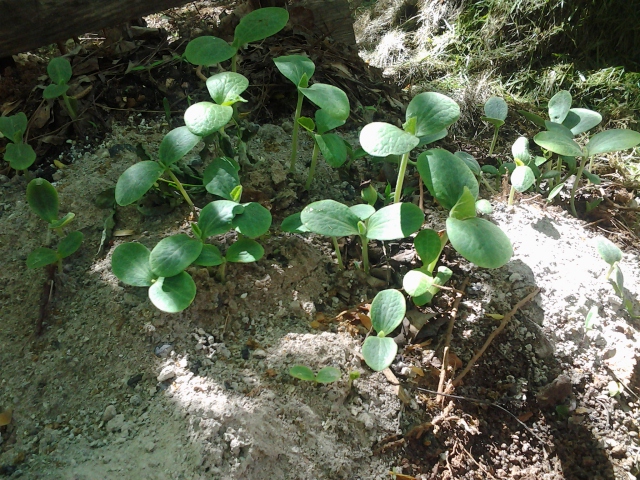
Last year a friend had a particularly productive winter squash patch and we feasted on squash all winter.  Now our compost pile is overrun with squash seedlings, deep green and veined and beautiful, but doomed.  They are competing for sun, water, space, and most will not survive.  Beside the compost pile is a small mountain of grass clippings; I stalk the neighborhood with my wheelbarrow and cart them away.  There is always more than I can carry this time of year.  But a few months ago—nothing.

20130425_15375020130425_153817

I’ve been letting this sink in today.  Could it be that there is nothing wrong with me?  Could it be that is is natural to have periods of deep, flowering, intense productivity followed by a fallow season?  Could it be that there is no such thing as life balance?   Continue reading

6 Comments

April 26, 2013 · 1:44 am